


March 31, 2026
Possessing a robust conceptual model of motor skill acquisition is a strategically important requirement for every human movement professional. Its relevance extends across a broad spectrum of disciplines, from the organization of coaching and teaching sessions to the planning of therapeutic and rehabilitation programs, as well as the design of ergonomic equipment. For decades, the field has been dominated by a fundamental dichotomy: on the one hand, traditional theories that model the brain as a computer, executing pre-stored motor programs; on the other, a contemporary approach that views the athlete as a complex dynamic system in continuous interaction with the environment. The purpose of this essay is to examine this fundamental paradigm shift, illustrating how the Constraints-Led Approach provides a more powerful and accurate framework, with profound practical implications for all movement professionals. To fully understand the scope of this conceptual revolution, it is essential to begin by examining the paradigm that has long formed the foundation of our approach to learning.
——————————————————————————–
Traditional theories of motor skill acquisition have been profoundly influenced by the rise of cognitive science and the powerful computer metaphor. Despite their differences, these models have provided, for decades, the language and concepts used to explain how the central nervous system (CNS) controls movement. Theoretical frameworks such as association theories, neuromaturational theories, Fitts’ stage theory, information-processing theories, and neurocomputational theories share a view of the learner as an information processor whose primary objective is to develop and refine internal representations of the world and of the actions required to interact with it.
The common characteristics of these approaches can be summarized as follows:
The practical implications of this paradigm are direct and pervasive. For a coach or teacher, the objective becomes helping the learner construct and memorize the “ideal” motor program. This translates into teaching methods that emphasize repetitive practice to “engrave” the program, task decomposition (part-task practice) into simpler components to reduce cognitive load, and the use of detailed verbal instructions to prescribe the correct technique. However, this paradigm’s inability to convincingly account for novelty, flexibility, and adaptability in movement—the so-called “degrees of freedom problem” introduced by Bernstein—has exposed its theoretical limitations and driven the search for a new perspective.
——————————————————————————–
The limitations of traditional models, particularly their difficulty in explaining the flexibility, novelty, and adaptability of human movement, have necessitated the adoption of a new theoretical framework. This alternative perspective no longer views the individual as an information processor, but as a complex dynamic system intrinsically coupled with its environment. This approach rests on two complementary theoretical pillars: Dynamic Systems Theory, which explains how movement patterns form, and Ecological Psychology, which clarifies how environmental information guides action. While Dynamic Systems Theory provides the “engine” of change—explaining how movement patterns emerge and self-organize—Ecological Psychology provides the “guidance system,” clarifying how environmental information specifies and shapes action.
Dynamic Systems Theory models the performer as a “complex system,” characterized by many interacting components (the degrees of freedom, such as muscles and joints), nonlinear behavior and, above all, the capacity for self-organization. This concept is fundamental: functional coordination patterns can emerge spontaneously from interactions among the system’s components in response to specific constraints, without the need for a central motor program to prescribe them. Natural examples of self-organization, such as the formation of bird flocks or schools of fish, illustrate how macroscopic order can arise from local interactions without a leader issuing commands.
Within this framework, stable and functional movement patterns are referred to as attractors. They represent the preferred states of the system because they correspond to configurations of maximum stability and energetic efficiency. The shift from one attractor to another, such as from walking to running as speed increases, is defined as a phase transition, a spontaneous change that occurs when a constraint—in this case, speed—reaches a critical value.
In sharp contrast with the traditional view of variability as “noise,” Dynamic Systems Theory considers variability a functional and indispensable property of the motor system. Variability is not an error to be eliminated, but a resource that enables flexibility, adaptation, and the exploration of new and more effective movement solutions.
An illuminating example is the so-called “funnel-shaped control,” observed by Bootsma & van Wieringen (1990) in expert table tennis players. At the beginning of the stroke, the racket trajectory displays a high degree of variability. This high initial variability is not a flaw, but a functional resource that allows the player to adapt in real time to the trajectory of the ball while simultaneously disguising their intentions from the opponent. As the movement progresses toward the point of contact, variability decreases dramatically, ensuring maximum precision at the critical moment of impact. This demonstrates that expert athletes do not eliminate variability; rather, they exploit it functionally.
Ecological Psychology, developed by J.J. Gibson, provides the second pillar by explaining the relationship between perception and action. Its central principle is direct perception: the information required to guide action is not cognitively processed from raw sensory data, but is instead directly picked up from the environment.
Together, these two theoretical pillars provide a radically different picture of the learner: no longer a computer executing programs, but a complex, self-organizing system tightly coupled with its environment, exploring and discovering functional movement solutions. The Constraints-Led Approach translates these powerful ideas into an operational framework for practice.
——————————————————————————–
The Constraints-Led Approach (CLA) represents the practical framework that integrates insights from Dynamic Systems Theory and Ecological Psychology. This approach fundamentally redefines learning: rather than memorizing a motor program, learning becomes a process of search and discovery in which movement solutions emerge from the dynamic interaction of a set of constraints. The movement professional does not teach a technique; rather, they guide this process of discovery.
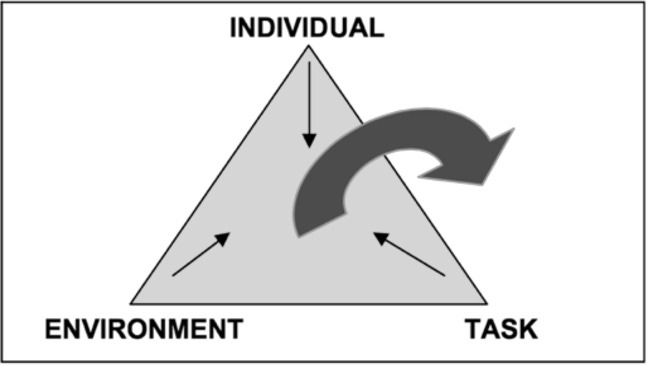
At the core of the CLA is the model proposed by Newell (1986), which classifies constraints into three interdependent categories. Observable motor behavior is the emergent result of the continuous interaction among these three elements.
| Constraint Category | Description and Examples |
| Organismic | These constraints are the unique characteristics of the individual. They include structural factors (e.g., genes, height, weight, strength) and functional factors (e.g., cognition, motivation, emotional state, intrinsic dynamics). |
| Environmental | These refer to global variables within the physical and social environment. Examples include gravity, light, temperature, the playing surface, as well as social and cultural expectations. |
| Task | These constraints are specific to the goal to be achieved. They include the rules of the game, equipment dimensions, and characteristics of the action space (e.g., boundary lines, nets, posts). |
To conceptualize the learning process within the CLA, the metaphor of the perceptual-motor landscape is used. Each learner possesses a unique landscape, shaped by the interaction of constraints, within which they search for stable and functional coordination states, or attractors—the deep valleys of the landscape.
Intrinsic dynamics represent the initial topography of the learner’s landscape: some valleys (movement patterns) are already deep and readily accessible, shaped by genetics and previous experience, while other areas remain unexplored and mountainous. In this context, the purpose of practice is to search, explore, discover, assemble, and stabilize functional and reliable movement patterns. The learner is guided toward discovering and stabilizing new and more effective valleys within the landscape through interaction with constraints skillfully manipulated by the practitioner.
This model requires a fundamental redefinition of the role of the coach, teacher, or therapist. Rather than an instructor prescribing a “correct” technique, the practitioner becomes a facilitator who designs the learning environment—an architect of constraints who guides the individual’s discovery process. This pedagogical approach is known as Nonlinear Pedagogy.
——————————————————————————–
Nonlinear Pedagogy is the practical application of the Constraints-Led Approach. It transforms the practitioner—whether coach, teacher, or therapist—into an “architect of the learning environment.” Their primary task is no longer to provide prescriptive instructions, but to strategically manipulate constraints to guide the learner toward the autonomous discovery of effective movement solutions. This “hands-off” approach promotes deeper, more adaptable, and more individualized learning.
The manipulation of task constraints is the most powerful tool available to the practitioner for shaping the learner’s perceptual-motor landscape.
Nonlinear Pedagogy also reconsiders how verbal instructions are delivered. Studies conducted by Wulf and colleagues have highlighted a critical distinction between two types of attentional focus:
Scientific evidence consistently demonstrates that an external focus leads to more effective learning, better skill retention, and more automatic performance. Verbal instructions, therefore, should not be used to prescribe a universal technique, but rather to direct the learner’s attention toward the environmental consequences of their actions, allowing the motor system to self-organize in order to achieve the goal.
Observational learning (modeling) is also reinterpreted. From the perspective of visual perception, what the observer picks up is not a sequence of static positions to imitate, but the relative motion between the model’s limbs and body segments. Demonstration, therefore, does not provide a “solution to copy,” but acts as an informational constraint that channels the learner’s exploration, accelerating the discovery of an individualized functional movement solution. Observing a functional solution helps the learner narrow the search space and converge more rapidly toward an effective coordination pattern suited to their own individual characteristics.
——————————————————————————–
This essay has traced a path from the reductionist model of the “brain as a computer” toward a holistic view of the “performer as a complex, self-organizing system,” demonstrating the necessity and superiority of the latter. The key message is that motor skills are not rigid programs stored within the nervous system, but flexible, emergent solutions arising from the continuous and dynamic interaction between the individual, the task, and the environment.
The strength of this approach lies in its respect for the complexity and uniqueness of every learner. Nonlinear Pedagogy, as the practical application of these principles, does not seek to suppress variability and individuality but instead harnesses them as drivers of learning. Rather than producing performers who execute standardized techniques, this approach develops individuals who are more adaptable, resilient, and autonomous in solving movement problems, providing practitioners not merely with a new set of tools, but with a new philosophy for cultivating human potential within its natural environment.