


November 10, 2025
1. Introduction: From Romanticism to Sport Science
The definition of an accurate performance model is now a strategic pillar for the delivery, planning, and programming of training in modern fencing. This scientific approach marks a decisive evolution from the past, when preparation was often entrusted to “artistic” methods and a sometimes “romantic” vision of the discipline. The current paradigm, firmly anchored to “Sport Science,” relies on the use of scientific research to provide crucial evidence that informs and optimizes daily sports practice, indicating what to train and how to do it effectively.
However, analyzing fencing presents unique challenges. The multitude of aspects characterizing combat—technical, tactical, physical, and psychological—does not allow for the creation of a fixed and stable performance model like that typical of endurance disciplines, for instance, where objective measures are more easily extrapolated. Despite this intrinsic complexity, fencing has progressively aligned itself with a scientific way of operating, recognizing that, although it is not an art, it is a sporting discipline in all respects, governed by trainable and measurable principles.
To fully understand the validity of the current model and its methodological superiority, it is essential to critically analyze the errors of the past that slowed its development.
2. Lessons from the Past: Critical Analysis of Obsolete Models
Understanding the historical errors made in athletic preparation is a crucial step to avoid repeating them and to appreciate the methodological evolution that led to today’s model. A retrospective analysis allows for the consolidation of current practices on a more solid and informed basis.
In the 1980s and the first half of the 1990s, an error was made that we might now call “crude,” particularly by athletic trainers coming from the world of track and field. The fallacious belief of the time was that maximizing conditional capacities (like explosive strength) had a direct correlation and transfer to winning. This view led to training programs that chased the peak of physical form, neglecting the complex and situational nature of combat.
The performance model of that period was, in fact, incomplete. Fencing was interpreted as a simple dexterity activity with a strong muscular component, focused almost exclusively on expressions of explosive and reactive-elastic strength. This model proved to be “partial” because it ignored an evident fact: the fencer does not act from a standstill but moves constantly on the strip at variable speeds, continuously adapting to the opponent. Believing that performance depended only on the explosive execution of specific techniques was a reductive and ineffective vision.
The overcoming of this paradigm occurred with the introduction of concepts such as block periodization and, above all, the pursuit of a continuous physical form rather than maximal peaks. This methodological change produced evident results for Italian fencing, allowing it to maintain extremely high competitiveness in an increasingly globalized sports context.
The key to overcoming the reductive models of the past was precisely the understanding of the variable and unpredictable nature of competition, forcing coaches and trainers to abandon the search for isolated physical peaks in favor of an integrated and situational approach.
3. The Nature of Competition: Fencing as an “Open Skill” Discipline
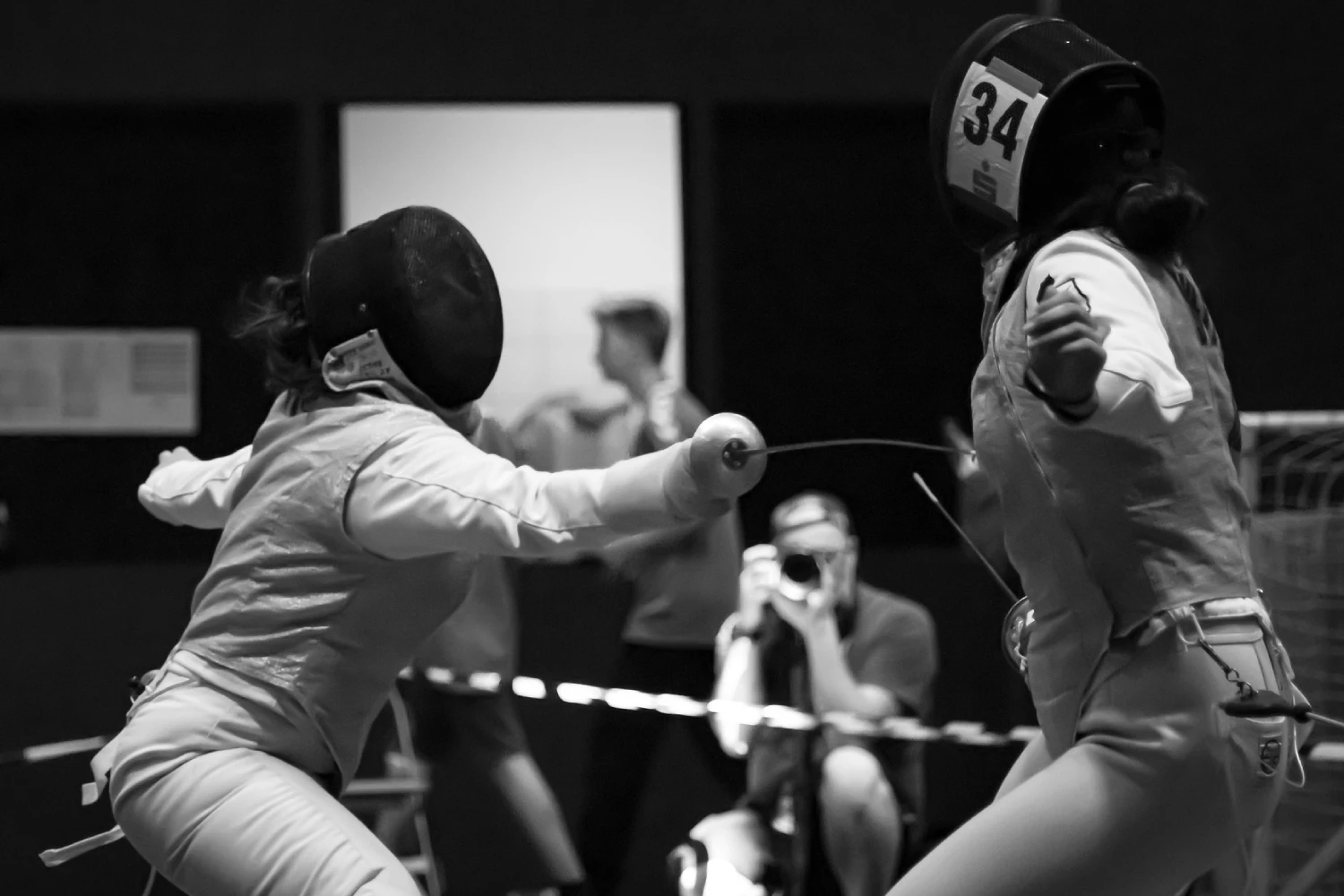
To understand the fencer’s real performance needs, it is strategically essential to frame fencing as an acyclic situational sport and, more generally, within its correct classification as an “open skill” discipline. The concept of “open skill” challenges the rigid classifications of the past and offers a much more accurate interpretive lens. A discipline is defined as “open skill” when the athlete must act in an unpredictable and continuously changing environment, adapting their actions in real time.
Fencing is the epitome of an “open skill” discipline. The fencer does not execute a standardized movement but constantly confronts the variables of an environment that changes at every moment. Their performance depends on the ability to correctly perceive and interpret these stimuli to produce an effective response. The main variability factors include:
This complexity emerges from the interaction of multiple factors that, together, make up the performance. The following table summarizes the main components involved.
| Factor Type | Specific Components |
| Perceptual | Perception of the environment and the opponent’s actions. |
| Cognitive | Activation, attention, focusing, and processing processes. |
| Metabolic | Dynamic interaction of energy systems. |
| Biomechanical | Technical expression of movement and fundamentals. |
To manage such complexity in a structured way, the modern performance model distinguishes between two fundamental categories of factors, creating a clear hierarchy for training.
4. The Structure of the Modern Model: Determining and Favorable Factors
The strategic value of the modern model lies in the clear distinction between determining factors and favorable factors of performance. This classification helps to avoid the confusion generated by the great variability of the discipline, preventing the risk of overestimating some aspects (like explosive strength in the past) or underestimating others (like endurance). It establishes a functional hierarchy that guides training programming.
The key difference between the two categories lies in their relationship to the final result:
4.1. The Determining Factors: The Foundation of Performance
The determining factors represent the core of fencing performance. They constitute the heritage of technical and tactical skills that the athlete acquires and perfects through specific discipline training. They are the true essence of the fencer.
Their main characteristics can be summarized as follows:
These factors are the actual “foundations of performance,” the set of fencing skills that ultimately decide the outcome of a bout.
4.2. The Favorable Factors: The Catalysts for Improvement
Favorable factors are those components which, although not directly and significantly correlated with winning, act as catalysts capable of enhancing performance. Their development creates the optimal conditions for the determining factors to express themselves at their maximum potential.
The main components of favorable factors include:
This is where the conceptual error of the past is corrected: neglecting the training of conditional capacities merely because they are not directly predictive of victory would be a serious mistake. Instead, they play a crucial role as “favorable” factors, supporting the athlete within a modern concept of continuous physical form, which allows for maintaining high performance throughout the season.
To illustrate the practical application of this model, let’s analyze the metabolic aspect, one of the most discussed and, in the past, most misunderstood favorable factors.
5. The Integrated Metabolic Approach in Modern Training
A strategic understanding of the metabolic demands in fencing is fundamental for optimizing physical preparation. An accurate analysis of the energy systems involved allows for overcoming old preconceptions and structuring training that is truly functional to the demands of competition.
The metabolic performance profile of fencing is now described as an alternating and intermittent aerobic-anaerobic regime. This definition contradicts the old classification that considered it an almost purely alactic-anaerobic activity, related only to the explosive moments of the touch. The reality of combat is much more complex and requires the synergistic intervention of all metabolic pathways, as illustrated in the following table.
| Metabolic System | Specific Function in Fencing | Bout Moments |
| Alactic-Anaerobic | Sustaining explosive efforts for the resolution of the touch. | Execution of technical fundamentals aimed at the touch. |
| Lactic-Anaerobic | Intervening in short-duration but high-intensity actions. | Repeated movements, changes of direction, fast and repeated technical actions. |
| Aerobic | Acting in low-intensity phases and supporting recovery. | Study phases, “feinting,” paying off lactic and alactic oxygen debts during the bout and in the break. |
This integrated vision explains why endurance training (both basic and special) is now considered an essential favorable factor. For a long time deemed useless, if not even harmful, recent studies (starting with those by Alberto Bressan) have instead demonstrated its usefulness in sustaining performance during prolonged bouts and long tournaments. An efficient aerobic system allows for faster recovery between high-intensity actions and between one bout and the next, maintaining technical and tactical clarity.
The integration of all these elements defines the operational model for the modern coach and trainer.
6. Strategic Synthesis: Building the Modern Fencer’s Performance
In conclusion, the central thesis of this analysis is that performance in modern fencing does not result from the maximization of a single factor, but from an balanced and flexible integration of various components. The era of the exasperated specialization of a single physical capacity has ended, giving way to a holistic approach.
The updated performance model is based on a clear architecture: performance is the result of controlling and developing the determining factors (the heritage of skills, technique, and tactics, but also the quality of instruction and individual predisposition) in synergy with the evaluation and targeted training of the favorable factors (development of conditional capacities, programming, monitoring of fatigue and recovery). The former constitutes the foundations, the latter are the pillars that support and amplify their expression.
It is crucial that this model remains flexible and non-rigid, capable of adapting to the countless variables of the discipline, such as different fighting styles, the athlete’s anthropometric characteristics, the changeability of opponents, and the peculiarities of each weapon (foil, épée, and sabre).
The final recommendation for coaches and athletic trainers is therefore to adopt this integrated approach, which ensures that no fundamental aspect is neglected in the athlete’s construction. While recognizing the crucial importance of physical preparation and scientific monitoring, one must never forget that fencing technique and tactics remain, and will remain until proven otherwise, the true foundations of performance.