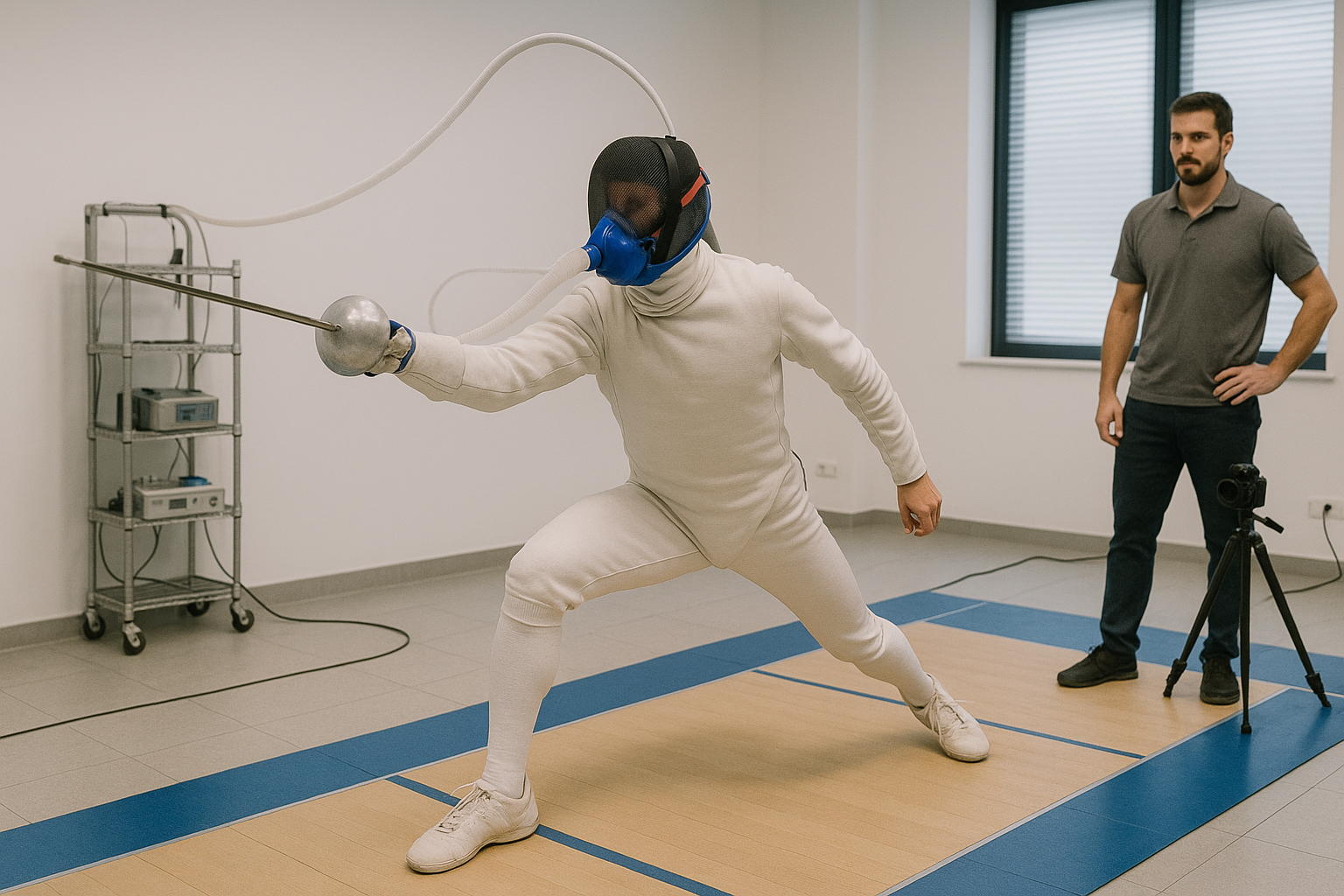
The study “A Test for Determining Endurance Capacity in Fencers” (Weichenberger et al., 2012)
October 29, 2025
The study “A Test for Determining Endurance Capacity in Fencers” (Weichenberger et al., 2012) proposes and validates a specific incremental test for fencing – the Fencing-specific Endurance Test (FET) – to assess fencers’ aerobic capacity under realistic conditions comparable to combat.
General Information
Authors: M. Weichenberger, Y. Liu, J.M. Steinacker Institution: Section of Sports Medicine and Rehabilitation, University of Ulm, Germany Publication: International Journal of Sports Medicine, 2012
Context and Objectives
Fencing is a combat sport with tournaments lasting up to 11 hours, where athletes must face bouts lasting from 3 to 9 minutes. During the bouts, fencers move with repeated asymmetrical steps and changes of direction, covering distances between 250-1000 meters on a 14-meter strip.
Problem: Until now, fencers’ aerobic capacity was tested using non-specific ergometers (treadmill, cycle ergometer), despite the movement patterns in fencing being considerably different.
Study Objectives:
Develop and evaluate a fencing-specific endurance test (FET)
Compare it with conventional tests
Verify if it can distinguish between fencers of different levels
Operational Methodology
Study 1: FET Evaluation
Participants: 28 German athletes (13 females, 15 males)
Age: $16.8 \pm 1.3$ years
Height: $177.1 \pm 8.5$ cm
Weight: $68.8 \pm 10.9$ kg
Level: national and international (foil and épée)
Protocol:
4 tests in randomized order with 3 days of recovery between tests
Fencing-specific endurance test (FET)
Treadmill test (TM)
Cycle ergometer test (CE)
Fencing bouts (BOU)
Study 2: Level Discrimination
Participants: 39 German male fencers
Elite (ELI): 19 international level athletes ($17.9 \pm 1.7$ years, $184.0 \pm 6.3$ cm, $77.7 \pm 8.9$ kg)
Non-Elite (NON): 20 national level athletes ($16.4 \pm 1.2$ years, $181.6 \pm 8.1$ cm, $73.1 \pm 9.7$ kg)
Test Descriptions
Fencing-Specific Test (FET)
Characteristics:
Performed on a fencing strip (7 meters)
Forward-backward movement using fencing-specific steps
Maintaining the weapon in the standard position
Change of direction at 0 and 7 meters
Incremental protocol:
Initial speed: 3 km/h
Increments: 1 km/h every 3 minutes
Computerized visual and acoustic signals for pacing
30-second pauses for lactate sampling
Continuation until exhaustion
Treadmill Test (TM)
Initial speed: 6 km/h
Incline: 1.5%
Increments: 2 km/h every 3 minutes
30-second pauses between levels
Cycle Ergometer Test (CE)
Initial load: 50 watts
Increments: 25 watts every 3 minutes
Measurement every 3 minutes before the increment
Fencing Bouts (BOU)
3 bouts against different opponents
Duration: up to 5 touches or 3 minutes
Conforming to tournament rules
Measurements
For all tests:
Blood Lactate: $20 \mu l$ capillary sample
Heart Rate: continuous monitoring
Speed/Power: recording at various levels
Main Results
Comparison between Tests and Bouts
Lactate during bouts (BOU):
Mean: 1.7 mmol/l
Range: 0.9-2.5 mmol/l
Indicates intensity in the aerobic range
Heart rate during bouts:
Range: 120-194 bpm
Mean: $158.69 \pm 15.42$ bpm
Correlations with heart rate in bouts:
FET vs BOU: $r = 0.80$ (p < 0.01) - strong correlation
CE vs BOU: $r = 0.38$ (p < 0.01) - weak correlation
Mean heart rate differences with BOU:
FET: 3.4 bpm (limits: -8.2 to 14.9 bpm)
TM: 20.4 bpm (limits: -7.2 to 47.9 bpm)
CE: 31.2 bpm (limits: -8.3 to 70.8 bpm)
Heart Rate at Different Lactate Levels
At the same lactate concentration, heart rate was significantly higher in the FET compared to the other tests:
Lactate
FET
TM
CE
2 mmol/l
165.1 bpm
$149.7 \text{ bpm}^*$
$135.9 \text{ bpm}^\#$
3 mmol/l
176.6 bpm
$166.0 \text{ bpm}^*$
$150.5 \text{ bpm}^\#$
4 mmol/l
183.2 bpm
$174.3 \text{ bpm}^*$
$160.3 \text{ bpm}^\#$
Max
192.6 bpm
193.0 bpm
$183.2 \text{ bpm}^\#$
*p < 0.01 vs CE; #p < 0.01 vs FET
Maximum Values
Parameter
FET
TM
CE
Max HR
$192.6 \pm 9.1$
$193.0 \pm 9.8$
$183.2 \pm 10.9$
Max Lactate
$7.2 \pm 2.0$
$9.6 \pm 2.9$
$8.8 \pm 1.9$
Max Speed
$8.1 \pm 0.9$ km/h
$13.1 \pm 1.7$ km/h
–
Rel. Max Power
–
–
$3.2 \pm 0.4$ W/kg
Level Discrimination
Elite fencers (ELI) showed significantly higher speeds than non-elites (NON) at all intensities:
Parameter
NON
ELI
Significance
Speed at 2 mmol/l
$5.03 \pm 0.87$ km/h
$5.86 \pm 1.07$ km/h
p < 0.05
Speed at 3 mmol/l
$5.87 \pm 0.63$ km/h
$6.62 \pm 1.13$ km/h
p < 0.05
Speed at 4 mmol/l
$6.26 \pm 0.75$ km/h
$7.02 \pm 1.31$ km/h
p < 0.05
Maximum Speed
$7.44 \pm 0.73$ km/h
$8.40 \pm 1.07$ km/h
p < 0.01
Correlations between Tests
Performance in conventional tests correlated weakly with the FET:
CE-FET at 2 mmol/l: $r = 0.30$ (p < 0.05)
TM-FET at 2 mmol/l: $r = 0.31$ (p < 0.05)
TM-CE: $r = 0.72$ (p < 0.01)
Study Conclusions
The FET is specific: it reproduces the physical load of fencing bouts better than conventional tests
Ecological Validity: the strong correlation ($r = 0.80$) between FET and real bouts demonstrates that the test accurately simulates the physiological demands of fencing
Discriminative Capacity: the FET effectively distinguishes between elite and non-elite fencers
Superiority over conventional tests: treadmill and cycle ergometer tests show significantly lower heart rates at the same metabolic intensity
Practical Applicability: the test is well-accepted by coaches and athletes
Practical Implications
REFERENCE VALUES FOR TRAINING
These values are useful for:
Customizing aerobic training intensity
Monitoring the progress of specific aerobic capacity
Predicting competitive potential
Lactate Threshold
Mean HR (FET)
Mean Speed (FET)
2 mmol/l
$165 \pm 13$ bpm
5.03–5.86 km/h (NON–ELI)
3 mmol/l
$177 \pm 10$ bpm
5.87–6.62 km/h
4 mmol/l
$183 \pm 10$ bpm
6.26–7.02 km/h
vMAX
$\sim 193$ bpm
7.4–8.4 km/h
Application:
Set interval training close to v@Lac3 and v@Lac4 values to improve specific endurance
Monitor individual response (HR/lactate) to calibrate loads
Use vMAX to test specific aerobic level and compare it over time
The FET allows for a more accurate assessment of fencing-specific endurance
It can be used to monitor the effects of specific training
Useful for training periodization and programming
Allows for the identification of specific aerobic capacities needed for competition
Limitations
Competition bouts were not examined
Limited sample, especially for female athletes
Need for future studies to verify the predictive capacity for competition success