


November 04, 2025
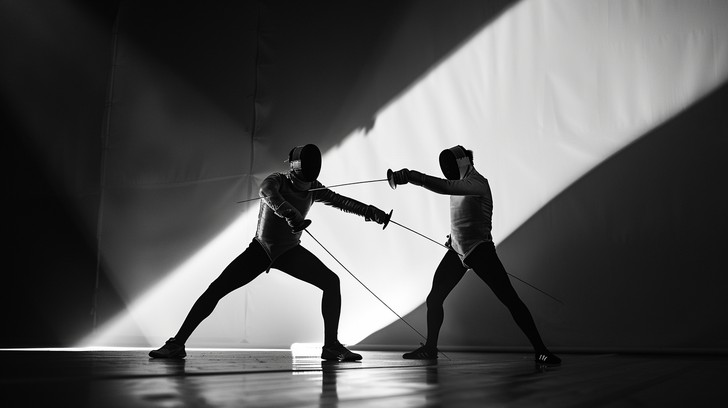
The individual lesson represents the beating heart of fencing pedagogy, a unique and unrepeatable moment in which the Master transmits their knowledge to the student through a dialogue made of gestures, movements, and technical corrections. This practice, rooted in the centuries-old tradition of fencing, still maintains an absolute centrality in the training of a fencer today.
The individual lesson is much more than a simple training session: it is a deeply personalized pedagogical experience where the Master acts as a true “intelligent opponent.” Unlike group lessons or free bouts, here the relationship is one-on-one, allowing for total attention to the student’s technical, tactical, and psychological specifics.
During the lesson, the Master holds their weapon (usually with a particular grip called the “French grip” even for other weapons) and simulates controlled combat situations, presenting targets, creating openings, provoking reactions, and immediately correcting errors. It is a dynamic dialogue where every action of the student finds a calibrated response from the Master.
The individual lesson pursues multiple interconnected objectives:
Technical refinement: The Master works on the effectiveness of fundamental movements – the lunge, the steps, the parries, the ripostes – correcting postural defects and inefficiencies. Every gesture is analyzed, broken down, and reconstructed until the most convenient form for the student facing the Master is achieved.
Tactical development: Through pre-established sequences or improvised situations, the student learns to recognize offensive opportunities, manage distance, vary rhythm, feint, and deceive the opponent. The Master creates scenarios that educate tactical thinking.
Psychological preparation: The lesson accustoms the student to pressure, the need for quick decisions, and managing errors. The Master can progressively increase intensity, simulating the tension of competition in a controlled environment.
Specific physical conditioning: The repeated movements under the Master’s guidance develop the muscle memory, specific endurance, and explosiveness necessary for fencing.
Although every Master has their own style, a lesson generally follows a logical progression:
Fencing warm-up: Basic movements to activate specific musculature and regain confidence with the weapon and distances.
Fundamental technical work: Execution of simple actions to consolidate the basics – direct attacks, parries-ripostes, elementary feints.
Development of complex sequences: More articulated combinations that require increasing coordination, memory, and precision.
Tactical-situational work: The Master presents variable situations where the student must choose the appropriate solution, developing decision-making skills.
Final check: The lesson often concludes with high-intensity sequences or controlled mini-bouts that test what has been learned.
Communication in the individual lesson is multi-modal and extraordinarily rich:
Verbal communication: The Master provides instructions, corrections, and encouragement. They use precise technical terminology that the student must learn and internalize. Words are often concise, immediate, synchronized with the action.
Body communication: The Master’s body “speaks” continuously – the position of the blade offers or denies targets, the distance invites or discourages attack, and movements suggest the correct timing.
Tactile feedback: Through the contact of the blades (the “feeling of the steel”), Master and student communicate intentions, pressures, and deception. This tactile dimension is peculiar to fencing and fundamental for developing sensitivity and intuition.
Immediate visual feedback: The student instantly sees if their action succeeds or fails, if they have hit the correct target, or if their posture is adequate.
An experienced Master personalizes each lesson based on numerous factors:
Technical level: A beginner needs systematic repetitions of the fundamentals, while an advanced athlete requires complex and variable situations.
Physical characteristics: Height, reach, speed, and endurance of the student determine which technical and tactical solutions are most appropriate.
Psychological aspects: Some students need constant encouragement, others continuous challenges; some learn better with detailed explanations, others through practical repetition.
Specific objectives: Preparation for an important competition requires a different approach than general training or recovery from an injury.
Current condition: The Master perceives the student’s physical and emotional state and modulates intensity and content accordingly.
The individual lesson follows a logic of progression that can be articulated across different time scales:
Progression within a single lesson: From simple to complex, from slow to fast, from predictable to unpredictable.
Progression in the weekly cycle: Alternation between technical, tactical, intensive, and refining lessons.
Seasonal progression: In the preparatory phases, work focuses on technique and conditioning; as competitions approach, tactics and specificity are emphasized.
Multi-year progression: From the novice learning the absolute fundamentals to the mature athlete perfecting subtle details and developing their personal style.
During the lesson, the Master has a rich arsenal of pedagogical tools:
Modulation of difficulty: They can make a target more or less accessible, slow down or speed up their reactions, and offer more or less obvious openings.
Intelligent repetition: This is not mere mechanics, but conscious – each repetition can contain small variations that keep attention high.
Constructive error: Sometimes the Master deliberately allows the student to make a mistake to then make them understand it viscerally through the immediate consequence.
Positive and negative reinforcement: Timely praise reinforces correct behavior, and immediate correction prevents defects from becoming consolidated.
Demonstration: The Master can personally execute the correct action, providing an immediate visual model.
Analogy and metaphor: Effective verbal images (“the blade like a whip,” “the wrist snapping like a spring”) facilitate kinesthetic understanding.
The individual lesson is also a powerful tool for psychological training:
Stress management: The Master can create controlled pressure, accustoming the student to maintain clarity and efficiency under tension.
Concentration development: The intensity of the interaction requires sustained attention for the entire duration of the lesson.
Confidence building: Gradual successes in the lesson reinforce the athlete’s self-efficacy.
Error processing: The lesson teaches that error is part of the learning process, not a failure.
Development of decision-making autonomy: Progressively, the Master leaves more choice to the student, preparing them for the independence of a real bout.
The individual lesson creates a special bond between Master and student, a relationship that transcends the mere transfer of technical skills:
Mutual trust: The student relies completely on the Master’s guidance, who in turn invests time, energy, and passion in the student’s growth.
Deep knowledge: Over time, the Master comes to intimately know the student’s strengths, weaknesses, reactions, and personality.
Pedagogical responsibility: The Master assumes responsibility for technical growth but also for the student’s physical safety and psychological well-being.
Transmission of values: Beyond technique, the Master transmits sports ethics, respect, discipline, and passion for fencing.
The ideal frequency of individual lessons varies according to the level and objectives:
Beginners: 1-2 weekly lessons of 15-20 minutes, sufficient to build fundamentals without overload.
Intermediates: 2-3 weekly lessons of 20-30 minutes, to consolidate and expand the technical-tactical repertoire.
Competitive athletes: 3-5 weekly lessons of 20-40 minutes, with varying intensity and content according to the period of the season.
Elite athletes: Daily or multiple daily lessons during intensive preparation periods, with sessions that can reach 40-60 minutes.
The individual lesson, although central, is not isolated but integrates with:
Group lessons: Where common elements are worked on and group cohesion is developed.
Free bouts: Where what was learned in the lesson is tested in a competitive context.
Athletic preparation: Which provides the necessary physical basis to express the technique.
Video analysis: Which allows for visual and cognitive understanding of what was kinesthetically perceived.
Competitions: The final testing ground where everything converges.
The individual lesson has ancient roots dating back to the Italian and Spanish Renaissance fencing schools. Over the centuries, it has undergone evolutions:
Classical tradition: Emphasis on method, rigorous progression, and perfect form before application.
Modern approach: Greater flexibility, integration of biomechanical and physiological knowledge, and intensive personalization.
Contemporary influences: Incorporation of elements from sports psychology, video analysis, and advanced athletic preparation.
However, the essential core – the direct Master-student relationship mediated by the weapon – remains unchanged, testifying to the validity of a pedagogical method that has spanned centuries.
Conducting effective individual lessons requires multiple skills from the Master:
Technical mastery: They must possess a highly evolved technique in all situations and know how to demonstrate it.
Pedagogical sensitivity: They must intuit the student’s needs, adapt language and methods, and motivate effectively.
Physical endurance: Giving multiple daily lessons is physically very demanding, requiring specific conditioning.
Observational capacity: They must instantly identify even minimal errors in the student’s movement.
Didactic creativity: They must continually vary exercises and situations to maintain interest and effectiveness.
Emotional balance: They must manage their own emotions and those of the students, especially during difficult times.
The individual lesson develops qualities that transcend the sport:
Discipline and consistency: Progression requires systematic commitment over time.
Concentration ability: The intensity of the interaction trains focused attention.
Frustration management: The inevitable errors teach resilience and perseverance.
Respect and humility: The student learns to accept guidance and recognize superior experience.
Growing autonomy: The ability for self-correction and self-assessment progressively develops.
The individual fencing lesson with the Master represents a unique form of teaching in the sports panorama, combining centuries-old tradition and pedagogical innovation, technical rigor and intense personalization, physical development, and mental training. It is the place where fencing is transmitted not only as a set of technical gestures but as art, science, and a philosophy of movement and life.
In an era of standardization and digitalization, the individual lesson remains a bastion of humanity, where the athlete’s growth necessarily passes through the deep relationship with a Master, through the contact of the blades, through that silent dialogue made of touches, parries, feints, and ripostes that only fencing knows. It is in this intimate and intense space that not only technically competent fencers are forged, but complete athletes and, perhaps, better people.