


October 28, 2025
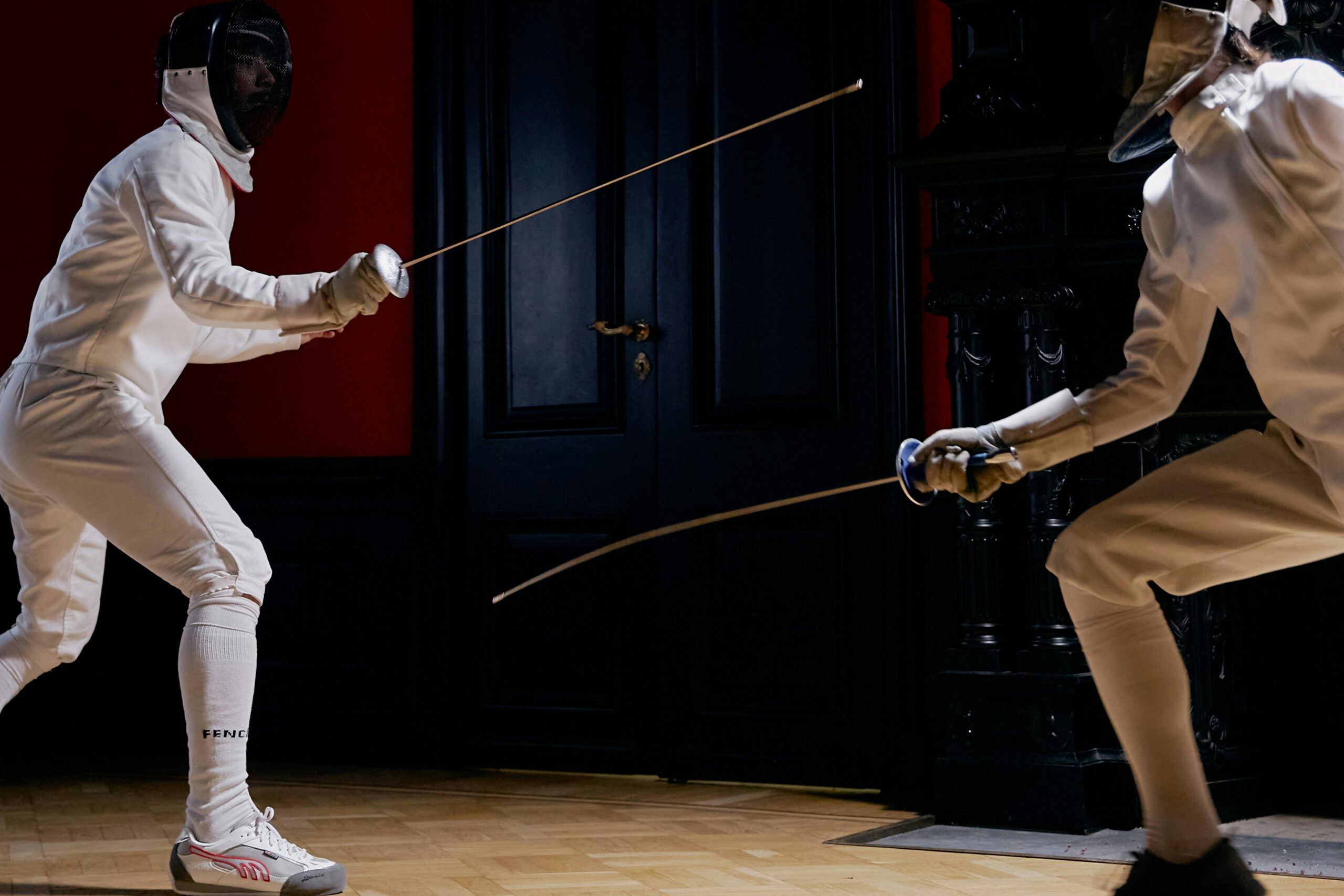
Fencing is one of the oldest sports still present in the Olympic panorama. Born as a martial art for dueling and self-defense, today it is a highly technical, regulated, and spectacular discipline. It retains the elegance and chivalrous values of the past, but presents itself with the modern face of a sport that looks to the future, thanks to technology, methodology, and inclusivity.
Fencing is rooted in European military and noble history. The **foil** (fioretto) was born as a training weapon in French and Italian courts, used to refine technique and precision. Fencing has been present since the first modern Olympics in 1896, and women’s foil entered the Olympic program in 1924.
The introduction of **electric signaling** revolutionized the fairness and precision of matches. Today, tools such as **video replay**, electronic sensing strips, and video analysis have elevated the technical and arbitral level, making fencing one of the most technologically refined sports.
In foil, the ‘**priority**’ (or right of attack) represents the legacy of an ethical code that distinguishes between who ‘starts’ and who ‘reacts’. The referee becomes the guarantor of compliance with a complex yet coherent system that values technique, control, and elegance.
Fencing is often called a ‘**chess match at 300 km/h**’. In addition to speed and explosive strength, it requires anticipation, reading the opponent, tactical choices, and stress management. It is a sport that develops deep mental capacities.
Traditionally dominated by European countries like Italy and France, fencing has seen rapid expansion in Asia (South Korea, Japan, China), in North and South America. International growth is also favored by projects from the FIE (Fédération Internationale d’Escrime).
Suitable for children, youth, and adults, fencing promotes values such as **respect**, **self-control**, and **discipline**. It is also increasingly inclusive: **parafencing** and women’s activity are integral parts of high-level competitions.
Despite not enjoying the media visibility of other sports, fencing has an active and passionate global community. The technical complexity makes immediate enjoyment difficult, but at the same time, it fascinates those who approach it with curiosity and a desire to understand.
The constant individual confrontation educates personal responsibility. Learning to win with elegance and to lose with clarity makes fencing a tool for human growth, as well as sporting growth.
Fencing is not just an inheritance from the past, but a laboratory for the future of sport. Technique, educational values, and innovation harmoniously coexist on a 14-meter strip. Those who practice fencing today experience a discipline that unites elegance and strategy, tradition and progress.