


November 03, 2025
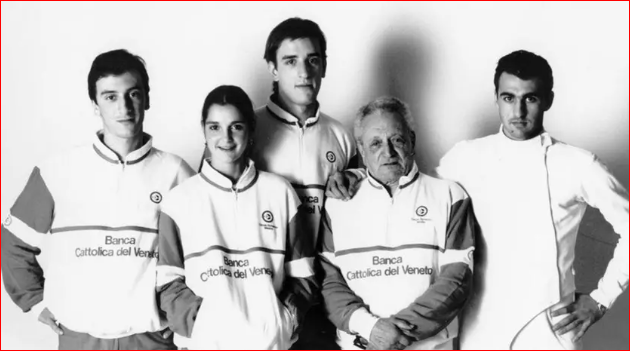
In Mestre, Di Rosa founded an educational laboratory that combined **technical rigor and methodological innovation**, anticipating many principles that are central today in sports science.
In an era when the Master (Maestro) was still seen as a vertical authority, Di Rosa introduced a more **cooperative** concept of the master–student relationship: no longer mere transmission of movements, but the **progressive construction of technical-tactical behavior**.
The “Mestre school” under Di Rosa distinguished itself through at least five innovative elements, documented both in oral tradition and in the technical accounts of his students:
a. Centrality of Perception and Tactical Choice
Di Rosa maintained that the foil fencer should “see, anticipate, and choose,” not merely react. The individual exercise was no longer mechanical repetition, but a **controlled perceptual situation**, in which the master induced the student to interpret the bout context.
This places him among the Italian precursors of **situational teaching** and, prospectively, of the ecological-dynamic approach.
b. The Inseparable Unit of Technique and Tactics
Against the tendency to separate the “technical lesson” (pure movement) from the “tactical lesson” (application), Di Rosa asserted that the technical gesture only made sense as a function of the tactical goal.
In foil, this meant that every action had to be built on the principle of **start-development-solution**: perception of the threat, construction of the attack or counter-time, and resolution with priority and distance.
c. Programming by Cycles and Objectives
The introduction of didactic cycles was his practical invention: he structured teaching into **phases of construction, stabilization, and variation**, in line with progressive motor learning.
The student was not “led to the final movement,” but “built over time.”
d. Collective Teaching and the Working Group
Di Rosa went beyond the individualistic view of the salle (fencing hall). He organized collective training sessions, where athletes interacted based on a common technical-tactical objective. Champions, non-champions, and children all trained together to encourage emulation and, above all, learning by imitation.
This not only optimized teaching time but also fostered **situational competence**.
The masters trained at the Mestre school have carried forward this model founded on:
It is no coincidence that many of Di Rosa’s students and students-of-students later populated the elite of Italian fencing, helping to maintain the foil as a weapon of national excellence.
Read through the modern categories of motor learning, Di Rosa’s teaching anticipates concepts found in:
Essentially, Di Rosa did not explain in scientific terms what he practiced empirically, but his approach was perfectly consistent with the future science of motor learning.
The “Mestre model” has had a lasting influence on foil teaching:
Maestro Di Rosa, for this reason, is considered a **bridge between classical fencing and modern fencing**. His work prepared the ground for the subsequent generations of his student Masters, who further systematized the methodology by introducing technical and tactical adaptations and updates.
Livio Di Rosa’s “revolution” was not a spectacular break, but a **profound transformation of the didactic mentality**.
He managed to combine technical rigor and cognitive freedom, mechanics and tactics, introducing into Italian fencing a logic of active learning that still constitutes the backbone of modern Italian foil.